

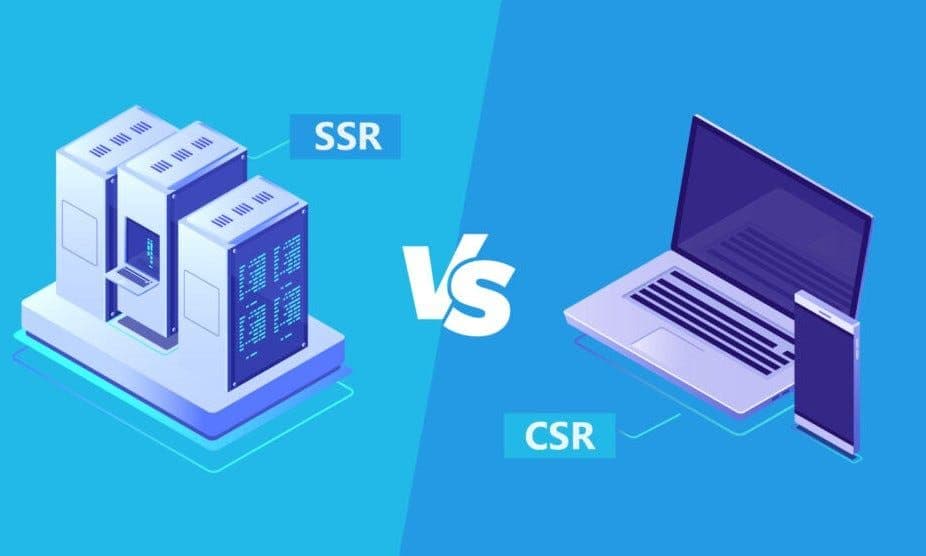
One of the most common architectural questions in modern web development is whether an application should rely on Server-Side Rendering (SSR) or Client-Side Rendering (CSR). Despite how often this topic comes up, the discussion is usually reduced to oversimplified claims: SSR is better for SEO, CSR is faster, Next.js solves everything.
In reality, rendering strategy is not about trends or tools — it’s about understanding where your application lives, who uses it, and what problems it needs to solve.
This article breaks down SSR and CSR from a practical perspective, focusing on real-world tradeoffs rather than theoretical definitions.
Understanding the Core Difference
With Client-Side Rendering, the browser receives a minimal HTML document and the application is rendered entirely using JavaScript. Data fetching happens after the page loads, and the UI is built dynamically on the client. This model has become popular because it enables highly interactive applications with relatively simple deployment setups.
Server-Side Rendering, on the other hand, generates HTML on the server before sending it to the browser. The user receives a fully rendered page immediately, which is later “hydrated” so it can behave like a client-side application.
Both approaches ultimately result in a JavaScript-driven UI. The difference lies in when and where the HTML is produced.
When Client-Side Rendering Is the Better Choice
CSR works exceptionally well for applications where SEO is not a primary concern. Dashboards, internal tools, admin panels, and authenticated applications are typical examples. In these cases, the user is already logged in, the content is not publicly indexed, and interactivity matters far more than first paint SEO metrics.
One of the biggest advantages of CSR is simplicity. There is no need to manage server caching, revalidation strategies, or hydration edge cases. The application logic lives primarily in one place, and deployment is often straightforward.
Modern CSR stacks have also evolved significantly. A good example is the BHVR stack (Bun, Hono, Vite, React) — a lightweight, full-stack client-oriented setup that prioritizes performance, simplicity, and control over infrastructure. It’s especially appealing if you want to avoid heavy framework abstractions or vendor lock-in and prefer something that is easy to self-host.
Note: A very solid and detailed walkthrough of the BHVR tech stack is available here:
https://www.youtube.com/watch?v=jXyTIQOfTTk
CSR is not a compromise in these scenarios — it’s often the most pragmatic and maintainable choice.
Where Server-Side Rendering Makes Sense
SSR shines when content needs to be publicly accessible, indexable, and fast to display. Marketing pages, blogs, documentation, and e-commerce product pages all benefit from sending fully rendered HTML to the browser.
Frameworks like Next.js, Angular Universal, and TanStack Start make SSR more approachable by abstracting much of the complexity. However, SSR is not free. It introduces additional considerations such as server costs, caching layers, revalidation strategies, and potential cold-start issues in serverless environments.
This is why SSR should be used intentionally. Applying it to fully authenticated dashboards or highly interactive tools often adds complexity without delivering meaningful benefits.
The Reality: Hybrid Rendering
Most real-world applications are not strictly SSR or CSR. A common and effective approach is hybrid rendering — using SSR or static generation for public pages, while keeping authenticated or interaction-heavy sections purely client-side.
This allows teams to benefit from SEO and fast first paint where it matters, without paying the operational cost of server rendering everywhere. Modern frameworks encourage this flexibility, but it still requires thoughtful architectural decisions.
Framework Choice and Vendor Lock-In
Rendering strategy is closely tied to framework choice. Next.js offers excellent SSR and hybrid capabilities, but often pushes teams toward specific hosting platforms. TanStack Start aims to reduce that coupling, while Angular SSR fits well in enterprise environments.
On the other end of the spectrum, CSR-first stacks like BHVR provide maximum control over hosting and infrastructure, at the cost of having to solve SEO and content rendering more deliberately.
There is no universally correct choice — only tradeoffs.
How to Make the Decision
Choosing between SSR and CSR should start with a few simple questions:
- Does this content need to be indexed?
- Is the application public or authenticated?
- How often does the content change?
- How much infrastructure complexity is acceptable?
- Is vendor lock-in a concern?
Answering these questions usually leads to a clear and defensible architectural decision.
Final Thoughts
SSR and CSR are not competing ideologies — they are tools. Used correctly, both can produce fast, scalable, and maintainable applications. Problems arise only when a rendering strategy is chosen by default rather than by intent.
Modern web development is less about picking the “best” framework and more about understanding the consequences of each architectural choice. Once you do that, the SSR vs CSR debate becomes much simpler — and far more productive.